How to Have Conversations About End-of-Life Wishes, Dementia, and Death—Practical, Gentle Ways to Start Talking Today
Grief can make reading hard. Want to listen to this article instead? Find its corresponding podcast episode here.
Somewhere in your life, there is probably a conversation you have been meaning to have.
Maybe it is with your parent, who still has not made a plan for their funeral.
Maybe it is with your partner, who changes the subject every time you bring up what would happen if one of you got seriously sick.
Maybe it is with yourself, and the vision of your own death you have never let yourself imagine long enough to meaningfully plan for.
You’re not avoiding this hard conversation because you are in denial, or because you don’t care. If you’re like many people, you’re avoiding it because almost nothing in our society teaches us how to start it.
I recently sat down with Lisa Pahl, a hospice social worker and the creator of a set of card games designed specifically to open up conversations about death, end-of-life care, and dementia, for an episode of my podcast, Grief Grower. Our conversation got me thinking about why these topics feel so difficult to broach in the first place, and what it actually takes to bring them into our closest everyday relationships—aka the people we interact with at dinner tables, in group chats, and on couches watching TV together.
Inspired by our interview, this article covers why many people avoid conversations about end-of-life and death, and gives you practical tips for how to start having them—even in small, abstract ways—with those you care about most.

Why We Avoid Talking About End-of-Life Wishes, Dementia Care, and Death
If you have never talked with your family or friends about death, dementia, or what you would want at the end of your own life, that does not mean you have done something wrong; it means you are like just about everybody else.
There is a strange contradiction at the center of how most of us relate to mortality: everyone dies—yet almost no one wants to talk about it before they have to.
Part of that is cultural. We live in a death-avoidant society that treats dying as something to whisper about, manage quietly behind the closed doors of a hospital, nursing home, or hospice facility, or outsource entirely to professionals once a crisis hits.
Part of it is also protective. For some people, talking about death can feel like inviting it closer, as though naming a fear makes it more likely to happen. Or it can feel like admitting vulnerability to people we love, opening the door to their fear alongside our own. Some of us avoid the topic because we are not sure our families or friends can emotionally handle it. Others avoid it because we are not sure we can handle it ourselves.
And some of us avoid it simply because no one ever showed us how to address it.
Not Having Tough End-of-Life Conversations Can Lead to Regret—or Questions
In our conversation, Lisa told me about the regret she’s witnessed again and again in hospice families—people who are navigating a terminal diagnosis with a loved one who is dying.
These regrets most often sound like, “I wish we would have had these conversations ahead of time, so I knew what my parent/sibling/friend/child would have wanted.”
Not having answers to important end-of-life questions can lead to even more questions.
Questions like:
Does your person prefer visitors or would they prefer to be alone, allowing loved ones to remember them in a certain way?
How do they feel about sensory experiences like touch, music, scented lotion or candles, or having the TV on in their room?
If they lose their ability to speak or write, who would they like to advocate on their behalf? Who should “speak” for them?
How do they feel about lifesaving measures—like being resuscitated after their heart stops or they go unconscious?
Do they want to receive religious care or be seen by a chaplain? Or would they prefer another spiritual experience?
When your person dies, how would they like to be remembered?
What would they like done with their body? Would they opt for burial, cremation, or something else?
What’s most heartbreaking about these questions—and eventual regrets—is that unlike death, which can’t be avoided, questions and regrets can. It’s common for people who’ve experienced the death of a loved one to grieve not only the loss of someone they really care about, but also the “coulda-woulda-shouldas” that go along with it—information they could have had if only they’d had the conversation.
Letting Past Regrets Guide Future Conversations
Because we live in such a death-averse society, regrets about a loved one’s end-of-life and death are common. But regret can be a catalyst for future change. As Lisa said in our interview: even if you never got the chance to ask someone who has already died about their wishes, you still have the opportunity to get curious about end-of-life questions with everyone else in your life.
That is not a small consolation. It’s guidance and direction towards how you can contribute to changing the end-of-life and death experiences of the people around you—including yourself.
For example, one of my most viral Instagram posts is about the death of my cat. In it, I share that when my mom died in 2013, I didn’t know I was allowed to ask for more time with her body. While she’d hurriedly written out her wishes for her funeral services on a yellow legal pad the day she found out she was dying and dictated which pieces of her possessions should go to which family members, we never discussed what she would like to happen with her body after her death. She died just seven days later, and the whole experience was a whirlwind of logistics and emotional waves.
I was 21 at the time, and I remember feeling unsettled by funeral home workers coming into our home just hours after she died and escorting my mom’s body away—my sister and I sitting in the kitchen watching it happen. Something in me wanted more ceremony for her—like a blessing over her body or a moment together with our whole family one last time—and I suspect that’s something she would’ve wanted too. But because I didn’t know it was an option—and we didn’t discuss it before she died—I didn’t know to advocate for it.
When my cat, Jiji, died in 2024, I knew better. My regrets about my mom’s death made me more aware of the choices and control I had in a situation where I knew the final result was his death. I did all kinds of things—including asking for more time with his body—that honored who he was and what he would have wanted. While there were many differences between my mom’s death and Jiji’s—including the pet/human divide—the missed opportunities I felt amidst one guided my insistence on having the tough conversations and speaking about end-of-life care openly in the other.
This can be true for you too.
Consider asking yourself: What questions about end-of-life or death would I have liked to have an answer for when it comes to my own losses? How can I let those questions guide my future actions and conversations with the people (or pets) I care about?
Death, Dementia, and End-of-Life Wishes Are Not the Same Conversation
Before diving into how to start talking about mortality with the people you love, it helps to know that "the death conversation" is not actually one conversation. It is several, and they ask different things of you.
Death
Talking about death in general, aka our own mortality, our fears, our curiosities, our humor about the great unknown, is often the easiest entry point. It does not require a diagnosis or a crisis. It can happen over a drink, on a long drive, or scrolling through the same unsettling headline together.
End-of-Life Wishes
Talking about end-of-life wishes gets more specific. This is where you start naming preferences: what kind of medical care you would or would not want, how you feel about visitors or touch as you decline, what you hope your final days might look and smell and sound like.
Dementia Care
And talking about dementia is its own category entirely, because dementia asks you to plan for a future version of yourself who may not be able to speak up for their own wishes. It requires imagining decisions in advance that someone else may eventually have to make on your behalf, which is its own act of trust and care.
None of these conversations need to happen all at once, and none of them need to be perfect. They can be revisited, updated, and reopened as many times as you need.
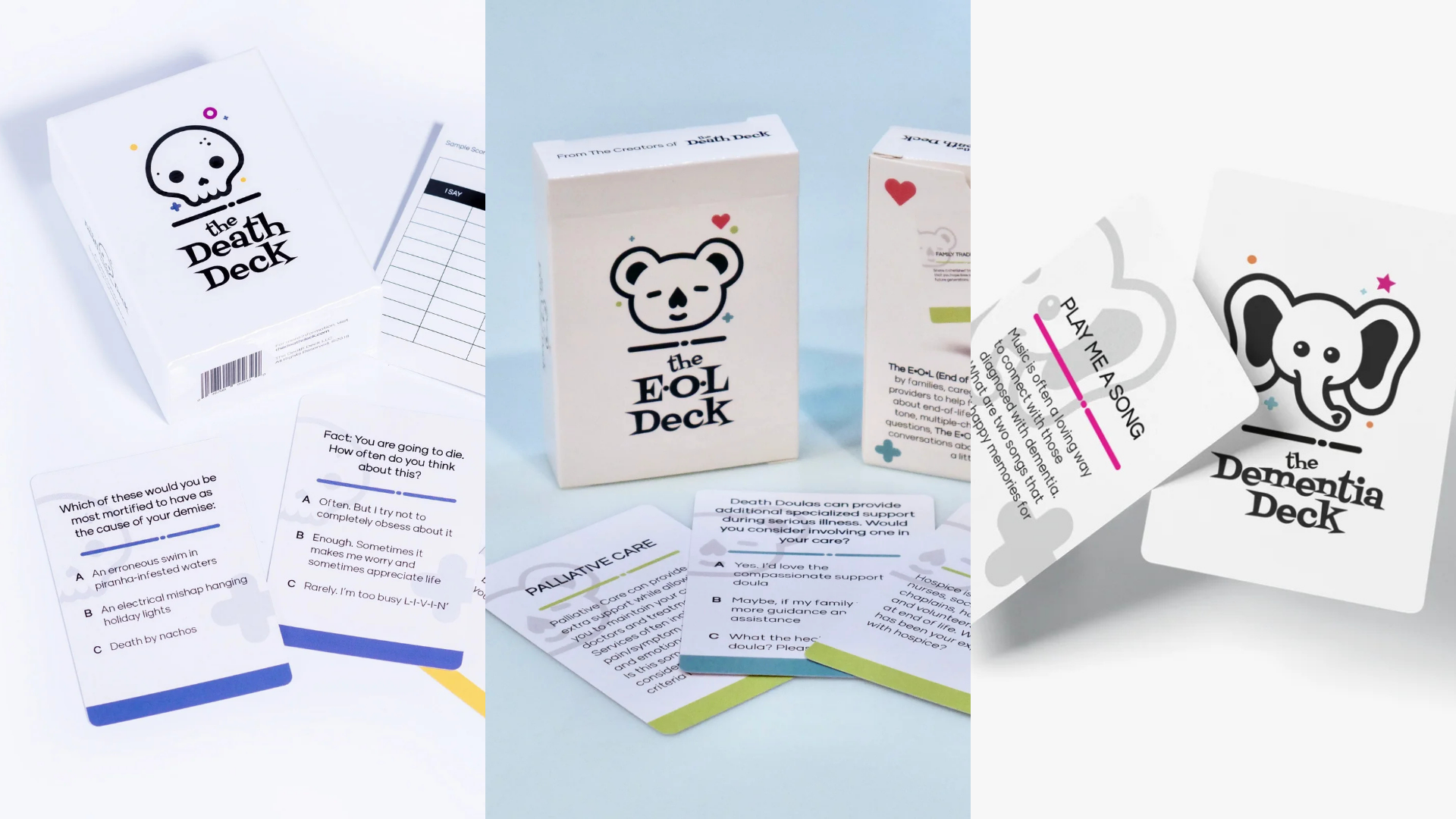
The Death Deck, The End-of-Life Deck, and The Dementia Deck card games for starting conversations, co-created by Lisa Pahl. Get 20% off your entire purchase at TheDeathDeck.com with code GRIEF20. | Credit: The Death Deck
How to Bring These Conversations Into Your Life
You do not need a terminal diagnosis or a health scare in your family or friend group to start talking about death, dementia, and end-of-life wishes. In fact, waiting for a crisis often makes the conversation harder, not easier, because it arrives already saturated in fear and urgency.
Here are a few low-pressure ways to start:
Start with the abstract before the personal.
If your family or friend group tends to shut these conversations down, begin with bigger, more philosophical questions, what people generally believe about dying well, rather than jumping straight to the hyper-personal "What do you want done with your body?" You can work your way from the general to the specific as trust builds. Questions like “Where do you think we go when we die?” or “Do you think people should be told the truth about a terminal diagnosis, or protected from it?” are more philosophical, abstract ways to initiate the conversation.
Answer the question first.
Similar to the oxygen mask rule—”Put on your own mask before assisting someone else with theirs.”—it can be helpful to answer a difficult question about end-of-life or death first before asking the same question of someone you care about. For instance, “When I die, I don’t want the TV on. I’d rather hear my mom’s favorite pianist playing—or someone in the room singing songs I know. How about you? Have you ever thought about it? What’s your vision of an ideal death?” Demonstrating that you’re willing to be vulnerable by going first can help the person you’re talking to feel more comfortable expressing their wishes.
Let a public death open the door.
When a celebrity, public figure, or someone in the news dies, it can be a strange but genuinely useful catalyst. A death that is not close to you personally creates emotional distance, which makes it easier to ask questions like "What do you think a good death looks like?" or "Would you ever want something like that written about you?" without it feeling like you are asking your own loved ones to confront their mortality head-on.
Watch TV shows and movies where death is portrayed.
Fiction gives you a shared, low-stakes reference point. After watching a character face a serious diagnosis, die suddenly, or navigate a loved one's decline, you can ask the people you are watching with: "How would you want that handled?" or "Did that feel like a good death to you, or a hard one?" These conversations tend to unfold more naturally than ones that start cold. My all-time favorite TV show, The Golden Girls, regularly has episodes discussing terminal illness, death, and even “where we go when we die.” While it’s an upbeat sitcom, it’s a great conversation starter for life’s harder moments.
Listen to podcasts that normalize the topic.
Shows like The Heart of Hospice, Julie: The Unwinding of the Miracle, Dying for Sex, Dying to Tell You, and my own show, Grief Grower, spend real time in these conversations, which can make them feel less foreign when you bring them into your own life. End Well is another wonderful resource, both as a podcast and as an annual conference dedicated entirely to reimagining end-of-life care in the United States and beyond. Sometimes hearing someone else talk openly about death is the permission you need to do the same.
Bring it up around a card game.
This is exactly the gap Lisa built her Death Deck, End of Life Deck, and Dementia Deck to fill: structured, sometimes funny, sometimes deeply tender questions that give you permission to ask things you might never think to bring up on your own. Think: We’re Not Really Strangers but for end-of-life and death! You do not need a special occasion to play. Leaving a deck out on the coffee table during a game night or a long weekend with friends can be enough of an invitation to flip over a card and talk about the multiple choice question, prompt, or fill-in-the-blank listed on it. You can see examples of question in each of Lisa’s decks on her website here. She has generously offered code GRIEF20 to get 20% off your entire purchase. Please note: This is not an affiliate link and I receive no commission from sales.
Use a holiday where you are the center of attention.
Lisa noted that birthdays, holidays, and milestone celebrations are natural openings to hard conversations. And because you’re the guest of honor, you can organize the day around what you would like to do! For instance, you might gather your family on your birthday and ask to answer ten questions, play a card game about end-of-life, or hire a death doula to guide everyone through a gentle mortality awareness meditation together. You can say something like, "I know we've been avoiding this topic, and I think it's important as I get older, so I want us to talk about it today." Being the guest of honor gives you a built-in permission slip to set the agenda.
Join a community where death and end-of-life conversations aren’t taboo.
While it may not be appropriate to join a grief support group to discuss how you or someone you care about might like to die—as those are generally intended to support those who’ve experienced a loss already—there are lots of other groups that cover end-of-life planning and death. Groups like Death Cafe and Death Over Drafts exist specifically to make these conversations social instead of solitary, whether that's over coffee and cake or beers with strangers who are just as curious as you are. Death Over Dinner offers a similar structure built around a shared meal.
The Order of the Good Death, created by funeral director and author Caitlin Doughty, is a great resource if you want to explore the broader death-positive movement online before showing up to an event in-person. One of former podcast guests, death doula Alua Arthur, also regularly hosts online workshops about planning for your own death or the death of someone you love. Her website features a free death doula directory of certified death doulas where you can search for someone educated in end-of-life matters in your state or country.
These Conversations Build Connection, Not Just Clarity
I could stop writing this article here, having covered the step-by-step logistics: start the conversation so there is a plan, so no one is left guessing, and so the practical pieces are handled before a crisis forces the issue. That’s more than most people do when it comes to talking about end-of-life and death.
But I want to keep going, because something else happens in these conversations too—something less practical and harder to plan for.
When you ask someone what they are afraid of, what they hope their final days feel like, or how they want to be remembered, you are not just gathering information. You gain access to a precious part of them that rarely gets air time in ordinary conversation.
Lisa told me about hosting card game nights where couples try to guess each other's answers and shared stories about receiving emails from family members who feel much closer to their loved ones as a result of having played The Death Deck or The EOL Deck. They were small, humbling reminders that talking about end-of-life wishes is not just about getting the details of how someone you care about wants to leave this world; it’s also about strengthening relationships and showing your love for them in different, deeper ways.
I think about this in my own life too. I know the secret story of the CD my friend stole from her older sister in middle school. I do not know how she wants to die. One of those facts is trivia. The other is something I will actually need to know one day, and something she deserves to have known about her. It’s another way I can love her.
Talking about death does not have to be heavy every time. Sometimes it is funny. Sometimes it is the most honest conversation you have all year. Either way, it tends to leave you closer than when you started.

Closing Thoughts: You Don't Have to Wait for a Crisis to Talk About Hard Things
You do not need a diagnosis, a health decline, or a death in the family to start talking about death, dementia, and end-of-life wishes with the people you love. You just need a small opening, a little courage, and permission to not get it perfect—or cover every single topic—on the first try.
Whatever loss or transition brought you to this article, whether that is the death of someone you love, a divorce or breakup, a difficult diagnosis, or another major life transition, you deserve support having conversations that our culture rarely teaches us how to have.
If you want to hear the full conversation that sparked this article, including more from Lisa Pahl on why she built the Death Deck, the End of Life Deck, and the Dementia Deck, you can this free episode of Grief Grower. And if you are ready to bring one of her lighthearted, helpful card decks into your own life, use code GRIEF20 for 20% off at thedeathdeck.com. Please note: This is not an affiliate link and I receive no commission from sales.
