6 Meaningful Ways to Honor Any Grief Anniversary—For Death, Divorce, and Beyond
Grief can make reading hard. Want to listen to this article instead? Find its corresponding podcast episode here.
When you’ve experienced a loss, chances are there's a date—or a few dates—on your calendar that stands out from the others.
Maybe it's the day your person died. Maybe it's the day your divorce was finalized or the day you got a diagnosis that changed everything. Maybe it’s the day you signed papers ending a job. Or the day you lost a friendship or the day you got the news that a version of your life you dreamed of could never come to be.
Whatever the date is, it might constantly exist as a glaring neon sign in your brain, looming larger as it approaches—and still visible in your mental rearview mirror once it passes.
Or you may forget about it the rest of the year, feeling it coming in your body before you even consciously register why. Perhaps your sleep gets weird or your patience gets short. Maybe you realize what time of year it is while standing in the cereal aisle wondering why you suddenly feel like crying.
That's not a coincidence. That's a grief anniversary!
And if you're wondering how to honor it—or if you're even "allowed" to make a big deal out of a day that may only be meaningful to you and your own heart—I want you to know that however you feel about that date is valid, no matter how much time has gone by, and whether your loss involved a death or not.
In this article, I'll share:
What a grief anniversary is—and how to pinpoint your own grief dates on the calendar
Why grief anniversaries aren't just about death, and why that matters
Six specific, practical ways to acknowledge a grief anniversary—no matter what type of loss you're honoring
How to scale your chosen ritual up or down depending on how much time, energy, or money you have available
Where to get the complete list of grief anniversary ideas, plus a printable calendar to plan for every grief date you carry
By the time you’ve finished reading, you’ll feel equipped to not only recognize where grief lives on your unique personal calendar, but also how to honor each grief date with care and intention.

What Is a Grief Anniversary?
A grief anniversary is any recurring date tied to a loss—one that tends to stir up grief no matter how much time has passed or whether anyone else is honoring the date with you.
You might be perpetually aware of it, bracing for it every year and breathing a sigh of relief when it passes and you get another 365 days before you see it again. Or you might be too swept up in life or other losses to notice it and be caught off-guard when it arrives.
Regardless of your awareness of it, the result is the same: this date on the calendar has a griefy impact on you.
Consider This: Your Grief Anniversary Might Not Be a Death Date at All
Most articles about grief anniversaries focus entirely on death-related losses. And death anniversaries absolutely deserve attention—they're often some of the hardest days of the year for grievers.
But if you've lived through a divorce, a life-altering diagnosis, an estrangement, a miscarriage, a layoff, or any other major life transition, you likely have dates on your calendar that ache in a very similar way, even though no obituary was ever written for them or no public funeral was held to memorialize their loss.
I learned the hard way after my then-fiancée suddenly broke off our engagement in May 2017 (three years after my mom died) that grief dates don’t limit themselves to death-related losses. They show up for all kinds of heartbreaks.
Through more than a decade of working with grievers, I've watched people carry equally weighty anniversary feelings around relationships that ended, bodies that changed, jobs that terminated, and futures that didn't happen—with almost nowhere to put that grief, because our society barely acknowledges they exist.
The Five Types of Grief Anniversaries
Through creating and leading my online support community Life After Loss Academy, I've discovered that grief anniversaries fall into five distinct categories—and most people are carrying more than one of them at once. The categories are a little clunky and imperfect, but they might help you recognize just how much of your calendar contains grief dates.
See how the following types of grief dates show up in your own life with loss:
Endings
These are often the death of a person, but they can also the be day a marriage legally concluded or a the day a breakup became official, the day you left a job, the day you moved out of a state or country, or the day you received a diagnosis that changed your future. Essentially, one chapter of your life ended in an impactful way, and this date is a marker of it.
Beginnings
These are often the birthday of someone who died, the day you adopted a pet you later lost, or the day a relationship started that has since ended. These dates are signifiers of a chapter of your life beginning—related to a loss. If it resonates, you can absolutely include your own birthday as a beginning date of sorts, as each year that goes by begins another 365 days of living with your losses anew.
Anniversaries
These are recurring personal dates like a wedding anniversary or a "sobriety day" that carries complex layers of grief. For example, I celebrate an “Alive Day,” every year on March 31, to commemorate the day in 2021 that I regained consciousness after a near-death seizure. I was grateful to be alive and also awestruck at how close I’d come to death. It was the first time I was hospitalized without my mom, which came with its own feelings of longing and missing. I mark “Alive Day” each year to remember the preciousness of life and the ever-present-ness of death.
Holidays
These are culturally or societally recognized days like Mother's Day, graduation season, Father's Day, Christmas, Hanukkah, Kwanza, Lunar New Year, Valentine’s Day Easter, Diwali, Eid al-Fitr, back-to-school season, Rosh Hashanah, Halloween, Dia de Muertos, or a religious observance that feels significant with regard to your grief.
Dates of Knowing
These aren’t applicable for everyone but are true for some grievers and include any day you discovered or received information about a loss—perhaps on the way to a loss or in the aftermath of a loss. This could be the day a doctor gave your loved one a prognosis, the day you uncovered your partner’s infidelity, or the day you found out your company had been acquired and layoffs were coming soon.
Dates of knowing can also apply to learning new, perspective-shifting information about a loss that has already happened. For instance, unearthing records that show a deceased family member had a different ancestral lineage than they claimed—or realizing symptoms from a current illness have been present since your childhood.
Once you sort your grief dates into these new categories, you might realize you’re not dreading just "one hard day a year." You’re navigating five or six—or perhaps dozens—scattered across the calendar, each one deserving its own kind of attention.
Next, let’s cover some simple, meaningful ways to honor a grief date.
Six Ways to Honor a Grief Anniversary
You don't need an elaborate plan to mark a grief date. If you’re like most grievers, you just need a handful of options you can reach for depending on your energy, your loss, and what feels true to you this year.
Here are six of my clients’ and students’ favorites to start with:
1. Light a Candle and Take a Moment to Pause
This is the simplest ritual on this list, and often the most underrated. There's something genuinely grounding about the small ceremony of striking a match, watching a flame catch, and giving yourself permission to sit in front of it for even 30-60 seconds.
You don't have to do anything profound while the candle burns. You can think about your person or pet who died. You can think about the relationship, the diagnosis, the job, the version of yourself that existed before the loss. You can say a prayer, hum a song, or just breathe and let your shoulders drop an inch.
(Obviously, use caution with an open flame, and never leave a lit candle unattended.)
2. Write a Letter
Writing a letter on a grief anniversary is one of the most flexible tools available to you, because it works for every single type of loss.
If your loss involved a person or pet who died, you might write to them directly—updating them on your life, telling them what you miss, or asking the questions you never got to ask. You might also make a list of things you remember about them based on the five senses—for example the smell of their favorite perfume or the sound of their voice.
If your loss was a divorce or a breakup, you might write a letter to the version of yourself who first said yes to entering the relationship, full of compassion instead of judgment. You might also write a petty airing of grievances that you tear up or put in a paper shredder. Both can be cathartic in their own aways.
If your loss was a diagnosis, you might write to your body, thanking it for what it's still carrying you through even on hard days.
Here are some more ideas for letter-writing related to a grief date:
Recall a significant memory that you cherish
Write about dreams or signs you’ve received or would like to receive
Reflect on a loved one’s impact on you, or on loss’s impact on your life
Write about people who have been there for you as you grieve
Comfort your inner child with words they need to hear right now
Write to a public figure or celebrity who has had a positive impact on your grieving process
You don't have to send the letter you write. You don't have to keep it either. You might (safely!) burn the letter after writing it as its own small ritual of release. Or your might tuck it into a drawer to reread next year, watching how your words shift over time—sort of its own measuring stick of growth through grief.
3. Order or Cook a Special Meal
Food carries memory in a way almost nothing else does.
Maybe you and your person who died had a standing Sunday dinner. Maybe your ex-spouse always made a specific dish for your anniversary, and reclaiming that recipe for yourself feels like taking something painful and making it yours again. Maybe, during a hospital stay for treatment, a particular takeout order became a small bright spot in an otherwise unbearable stretch of time.
On a grief anniversary, consider recreating that meal, ordering it if cooking feels like too much, or choosing something entirely new as a way of marking the day as its own occasion. If it feels right, pour something to toast with—even if you're toasting alone to another year you survived.
4. Take a Walk With Your Loss in Mind
Movement gives grief somewhere to go, and a walk is one of the most accessible ways to create that outlet.
Go somewhere old and meaningful, or somewhere entirely new, and move through it slowly, noticing what your person, your former relationship, or your former life might have noticed. Would your parent have pointed out that oddly shaped cloud? Would your ex have complained about the parking? Would the healthier version of your body have wanted to walk faster, or further, or without needing to stop and rest?
Or try playing grief “I Spy,” looking for signs and symbols related to your loss that mean something to you. You might also try taking what my friend and fellow grief author Lisa Keefauver calls a “Beauty Walk,” observing moments of beauty around you.
If walking isn't accessible to you, this same idea translates to a slow drive, a bus ride, or sitting outside somewhere you can watch the world move around you.
5. Immerse Yourself in Nature
There's a reason many grievers instinctively head outside on hard days. Nature doesn't ask you to perform anything. It doesn't need you to explain your loss or justify your emotions.
Whether it's a hike, a swim, sitting on a park bench, visiting a gravesite, or standing in your own backyard, being outside on a grief anniversary can offer a kind of living company that doesn't require conversation. Notice the small cycles of life happening around you—new buds on a tree, a spider building a web, leaves letting go of a branch. There's often a strange sort of comfort in watching endings and beginnings happen in the natural world on a day when you're sitting with your own.
It’s also incredibly grounding for your nervous system to be in nature—whether you’re surrounded by rain, birdsong, blooming flowers, fresh snow, shifting sand, or moving water.
6. Wear Something That Connects You to Your Loss
Grief doesn't have to be invisible or confined to the privacy of your home if you don’t want it to be.
Consider wearing a color your loved one always wore, a piece of their jewelry, or an item of clothing that still smells faintly like them if you're lucky enough to have one. If your loss was a diagnosis or a physical change, you might choose an accessory that represents the body or ability you're grieving. If your loss was a relationship, you might wear something that was always "yours" within that partnership, reclaiming it as entirely your own.
Or you might wear something new that reminds you of your loss. For instance, my best friend Tami loved Valentine’s Day. Every year on that holiday, I wear a pair of heart-shaped earrings I bought a year or two after her death. I would never wear them normally, but they remind me of her. To others, they’re just a kitschy holiday accessory. To me, they’re a cute symbol of our friendship and love.
No one else has to know why you chose to wear that specific article on your body. That's part of what makes this practice so powerful. You carry your grief with you, literally, without ever having to explain it to a single person.

Scale Your Ritual to Match Your Energy That Year
Here's something that doesn’t get said enough about grief anniversaries: the ritual that felt right last year might not fit this year, and that's not a failure or a deficiency on your part. It’s just how life goes sometimes.
Some years, you'll have the time, the capacity, and the emotional bandwidth to build something elaborate around a grief anniversary. Other years, that same date will land in the middle of an already hard season—a demanding work project, a new diagnosis, a move, a fresh loss stacked on top of an old one—and you simply won't have much of yourself left to give it.
Both of those years are allowed to look completely different from each other. But if you can use the exact same ritual as your starting point.
I teach this as a simple scaling framework: every ritual has six “dials” you can turn up or down depending on your energy.
Low energy looks like:
Less prep
Less people
Less money
Less travel
Less tech
Less time
High energy looks like:
More prep
More people
More money
More travel
More tech
More time
To illustrate, here’s how that plays out with the "order or cook a special meal" ritual. My mom died the day after Christmas, and one of my favorite positive sense memories with her is eating cinnamon rolls and ham on Christmas morning. My ideal ritual might be making both completely from scratch. In low energy years, I’ve bought pre-made cinnamon rolls and ham and warmed them up in the oven Christmas morning—often eating alone after a long holiday shift at work. In high energy years, this ritual has turned into a full homemade Christmas spread, cinnamon rolls and ham included, with my wife, sister, or other loved ones joining in. We’ve watched movies or opened presents together with my particular grief food as a center point of our gathering.
You can apply this same scaling to almost any ritual on this list. Take the "wear something that connects you to the loss" ritual, which relies mostly on prep. A low-prep version might be pulling on a T-shirt you already own that belonged to someone you care about who died. A high-prep version might be having a piece of sentimental clothing professionally remade into something new, like a jacket or a piece of jewelry, so you can wear a version of it every year going forward.
Or take the "write a letter" ritual, which also scales beautifully with prep. A low-prep version is a quick voice memo on your phone, spoken instead of written, so grief doesn't need to compete with your energy for finding the right words. A high-prep version might be an actual letter you write by hand, tucked into a keepsake box with photos and mailed to yourself so it arrives, like a small time capsule, right around next year's anniversary.
Travel is its own dial, and it shows up clearly in the "take a walk with your loss in mind" ritual. A low-travel version is walking around your own block or backyard. A high-travel version might mean planning an actual trip to a place that mattered—your person's favorite hiking trail, the beach where you got engaged before the divorce, the hospital courtyard where you sat during a hard diagnosis—so the walk itself becomes the whole day's ritual, not just a small part of it.
Tech is the dial people forget about most, and it shows up well in the "light a candle" ritual. A low-tech version is exactly what it sounds like: a candle, a quiet room, no phone in sight. A high-tech version might mean lighting that same candle over a video call with family members in different time zones, all lighting their own candles at the same moment, or putting together a digital slideshow of photos to play while it burns.
None of these versions of marking a grief date is more meaningful than the other. A cinnamon roll warmed up alone in a quiet kitchen can hold just as much honoring and acknowledgment as a table full of people. The point of scaling isn't to aim for "high energy" every year as some kind of goal. It's giving yourself permission to meet the day with whatever you actually have to offer it this time around, instead of forcing yourself into a ritual that doesn’t fit this season of your life.
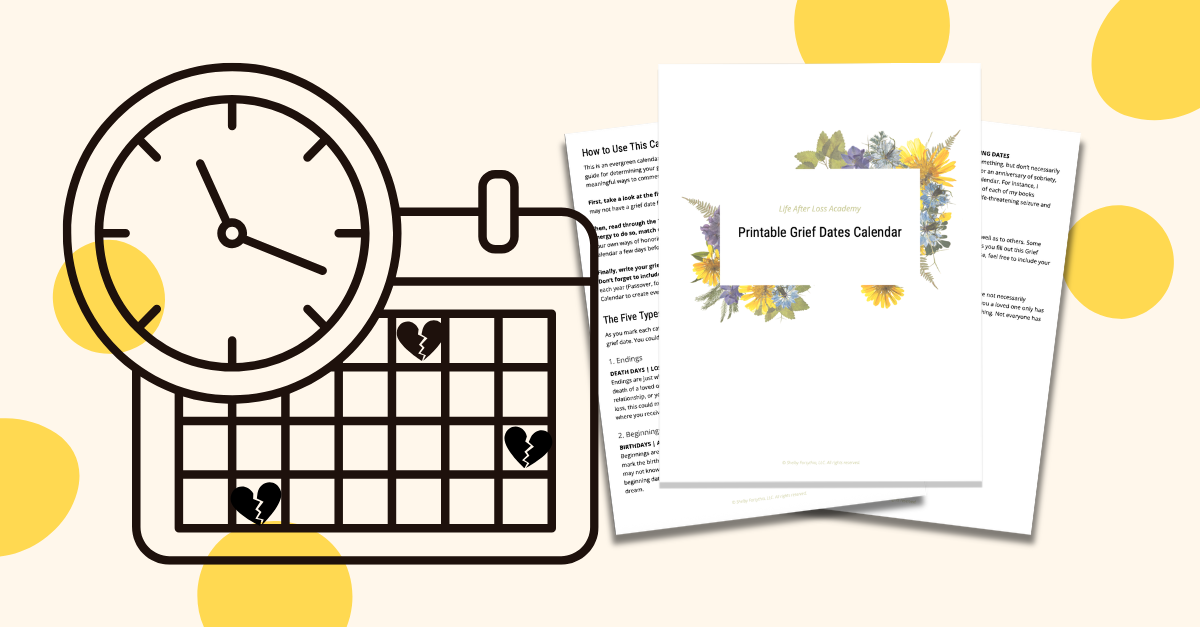
Get the Full List of Grief Anniversary Ideas—Plus a Printable Calendar to Plan Every Grief Date You Carry
I've put together a complete resource called the Printable Grief Dates Calendar, and it includes everything I couldn't fit into this article:
The full list of 13 ways to honor a grief anniversary—including creative options like hosting a low-pressure movie night, starting an evolving piece of art you add to each year, or subscribing to a delivery service as an act of self-care.
Tips for honoring specific grief dates vs. longer seasons of loss—such as the holiday season or a month of back-to-back grief dates.
A guided worksheet to help you identify and log every category of grief date that applies to your life—so you're never caught off guard by a grief date again.
A printable, evergreen monthly calendar you can use year after year—plus a list of culturally significant dates to watch out for each month. These include specific holidays like New Year’s and Halloween, but also seasons like back-to-school season.
You can grab the calendar as a standalone printable PDF, or get it by joining my online support community, Life After Loss Academy, where you'll also get weekly coaching with me and a monthly community post where LALA members share their grief dates for that month and support each other through them—because no one should have to navigate an entire year of hard dates alone.
Click here to get the Printable Grief Dates Calendar.
Click here to read student reviews and join Life After Loss Academy.

Closing Thoughts: Your Grief Anniversary Deserves a Plan, Not Just a Reaction
Many grievers want to honor their unique grief dates, but they don’t know where to start. I hope this article of ideas and the Printable Grief Dates Calendar are helpful guides to you as you make your plans for the year.
Having a small handful of go-to ways to acknowledge your grief anniversaries—instead of being caught off-guard or unprepared by them every single time—can turn a day you dread into a day where you take a little bit of your power back from grief. Because you actually get to choose how to spend it.
Wishing you lots of care and intention as you map out your own grief calendar. 🗓️
